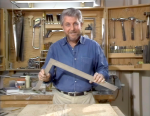
Few tools work harder in a home workshop than the carpenter's square. It lays out rafters and stairs and guides a clean cut across the end of a board.
All of that work depends on one thing: the square must hold a true right angle. A square that has drifted off true does more harm than having no square at all, because it carries its error into every line you mark.
Draw Two Lines to Find Out
Start with a piece of lumber that has at least one straight edge. Lay the square snugly against that edge and draw a line along its other arm.
Now flip the square over and set that arm directly on the line you just drew. Draw a second line right beside the first.
Parallel lines mean your square is true. Lines that flare away from each other mean it has bent out of true. In Ron's demonstration, the lines fanned apart because one arm had bent slightly inward. The gap was small, but it would have followed him into every cut.
What do you do if it's not square?
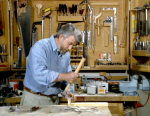
When an arm has bent inward, set a center punch just inside the square's inside corner and give it a tap with a hammer. The blow expands the metal at the corner and nudges the arms slightly outward.
If the square is out of true in the opposite direction, move the punch to the outside corner and tap again. This time the metal spreads on the outside, and the arms swing inward. The movement is slight, which is exactly what the job calls for.
Check It Once More
After you've tapped the corner, repeat the two-line test and take a good look at the result. When the lines run parallel, you can trust the square again.
So the next time you reach for your square, don't take its accuracy on faith. Check it first, and if it's off, you now know how to fix it.