HOUSE DOCTOR Transcript
HD027 “HOUSE PLANTS” from episode 618
RON:
Nothing makes your house come more alive than bringing a little nature inside. Before you invest in a house plant, you'll want to learn what an expert has to say. Here's plant authority Matthew Culmore.
MATTHEW:
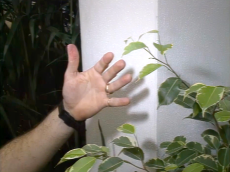
The most important factor in purchasing house plants is the determination of the light that you have available. While it's very easy to have too little light, it's very, very hard to have too much light. A simple test for determining the light would be what we call the shadow test.
What you're basically doing is utilizing your hand in between the source of light and the location where you actually want to put the plant. If it's a very hazy shadow, then most likely that's very low light. Or if you can get a shadow that would somewhat resemble being able to see whether it's a hand, whether it's all five fingers, then that would be what's considered as a medium light. Whereas if that shadow is very, very crisp, and it's a very defined, well-outlined shadow, then you're really talking about what's considered as a high light area.
The best plants that you can really select for low light areas would be your Chinese evergreens, your spathophyllums, and sansevierias. While the medium light plants, you'd be looking at dracaenas, some of the palm varieties, pleomelies. Some of the better high light plants are your ficuses, your true tree type of plants like scheffleras, and some of the other palms such as rafis and fishtails.
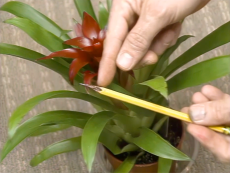
Probably the second most important factor after light to the individual with houseplants is going to fall in the watering area. By far more plants are over-watered than under-watered. The pencil test will quickly tell you whether the plant needs to be watered or not. If upon sticking the pencil tip into the soil, it comes up moist, then you do not need to water. If you find that the pencil comes up dry, then it is time to water.
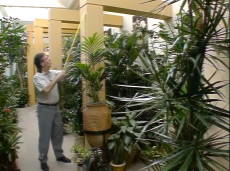
You need to go to and have personal contact with the plant on about a once a week basis. Feel the soil. That doesn't necessarily mean that you may have to water that day, but definitely check the soil for its moisture. Rotate the plant. Feather dust it or clean the foliage or remove any ratty foliage as it may appear. Aesthetically, a good rule of thumb when trying to select a plant proportionally for a site, you'd want to use the two-thirds rule, which simplified would be a nine-foot ceiling. You would want to use approximately an overall height of an approximately six-foot tall houseplant to keep aesthetic scale.
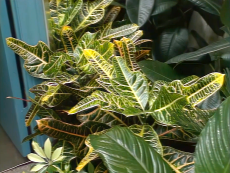
If it's a dark-colored area, one would probably be better in most cases to use a lighter-colored foliage, say a yellow-greenish foliage or something with variegation or other colors in it, so the plant stands out a little bit more, where in a very light or highly colored area, one would probably prefer a darker, richer green foliage as opposed to using perhaps a lot of color.
When considering also in sites that you're looking at for particular houseplants, is the plant going to be, as we were talking about, freestanding? If it were to be a freestanding plant, you'd obviously want foliage from the ground up, or if it's going to be a plant that's behind a piece of furniture, at that particular point, you could use something more of a tree or a cane type of plant because you don't really need to pay for foliage that you're not going to see down at the bottom that's obscured by either a piece of furniture or some other accessory of some sort.
Buying a houseplant should be just like buying a pet. You have to take into consideration the light, the water, the food, the environment that the plant is going to be in. Taking all of these factors into consideration, the final thing that you should have to think about is what am I going to do with this plant when it outgrows the space that it's in.